

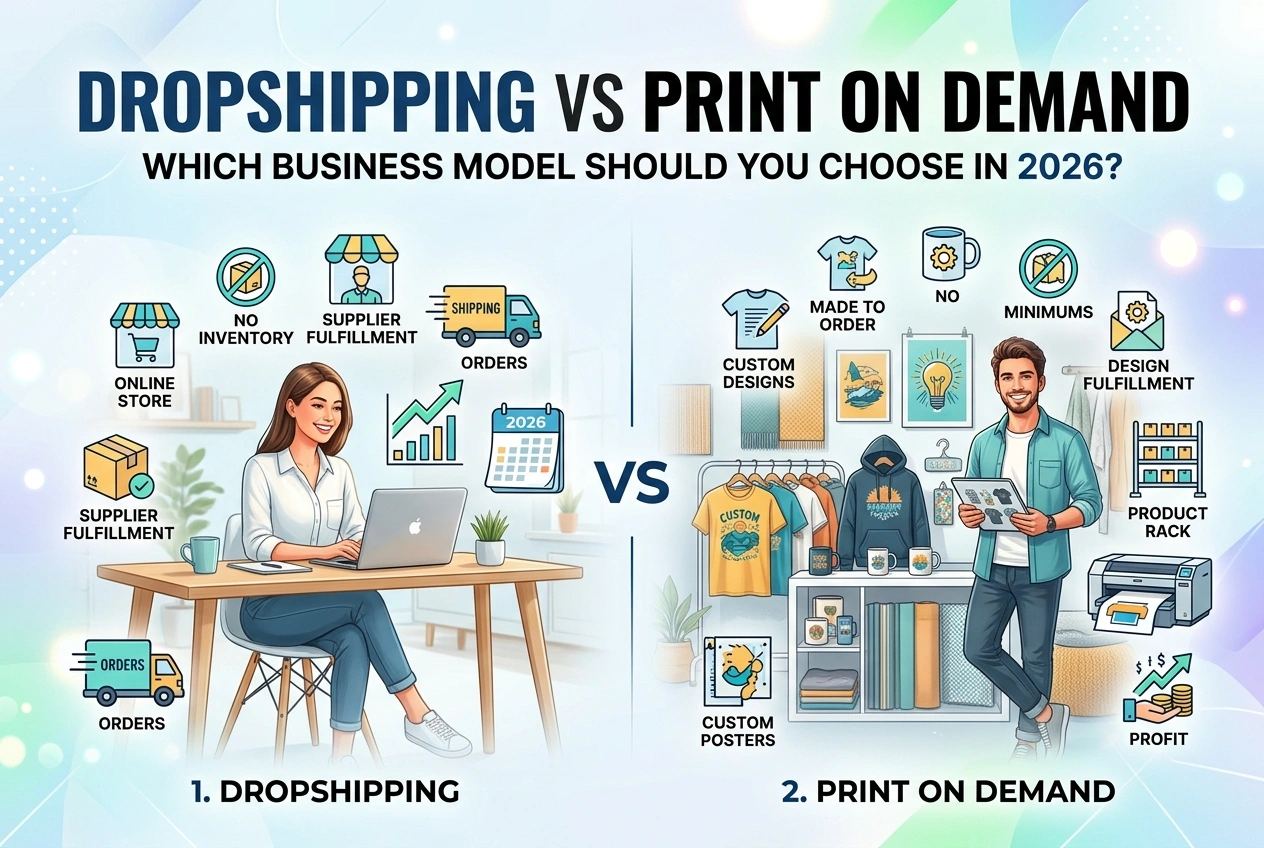
Dropshipping vs Print on Demand: Which Business Model Should You Choose in 2026?
They sound almost identical: you sell, someone else ships. No inventory, no warehouse, no upfront stock risk. But beyond that surface similarity, Dropshipping and Print on Demand are fundamentally different businesses.
One is a race to the lowest price. The other is a race to the best design and brand. One is easier to start; the other builds a real asset. This guide compares them head-to-head so you choose the right model from day one.
Quick Overview
| Dropshipping | Print on Demand | |
|---|---|---|
| Product Type | Ready-made generic goods | Custom-designed products made to order |
| Average Profit Margin | 15% – 30% | 30% – 60% |
| Competition Level | Extremely High | Moderate |
| Branding Potential | Low | High |
| Startup Difficulty | Easy | Moderate |
| Repeat Purchase Rate | Low | Medium to High |
| Product Control | None | Full design control |
How Each Model Works
Dropshipping
You sell standard products that already exist — phone cases, kitchen gadgets, beauty tools, furniture, electronics accessories. You source them from suppliers like AliExpress, CJ Dropshipping, or DSers. When a customer buys from your store, you buy the item from the supplier, who ships it directly to your customer under your name. You never touch the product. You compete on price, marketing, and store presentation.
Print on Demand
You sell products with your original designs printed on them — t-shirts, mugs, hoodies, posters, tote bags. The blank product exists, but the design is yours. When a customer orders, the supplier prints your design, ships it, and handles fulfillment. You compete on creativity, niche understanding, and brand identity.
Profit Margins and Pricing
Dropshipping
Because everyone sells the same items, price comparison is easy. Customers find the identical product cheaper elsewhere. This caps your margins. A $10 item might sell for $15–$18 after shipping and fees. Your profit: $3–$5 per sale. Many sellers compete on price until margins vanish entirely. High volume becomes your only path to meaningful income.
Print on Demand
Your design is the difference. Nobody else sells exactly what you created. Customers pay for the design, not just the blank shirt. A $9 t-shirt with your design easily sells for $25–$35, sometimes more in niche markets. After costs, you keep $10–$20 per sale. Higher margins mean fewer sales are needed to reach the same income. You do not need to be the cheapest — you need to be the most relevant.
Winner: Print on Demand — margins are typically double or triple those of dropshipping.
Competition and Differentiation
Dropshipping
Thousands of stores sell identical products from identical suppliers. When anyone can list an item in minutes, the market floods. Your only advantages become: faster shipping, better website design, better ads, or lower price. If you cannot beat on those, you lose. Building a brand is difficult because customers remember the product, not your store.
Print on Demand
Competition exists at the design level, not the product level. Two stores can sell t-shirts to dog owners and target completely different audiences. Your niche understanding and creativity are your moat. Great designs targeting specific audiences — retro gaming teachers, vintage camping lovers, minimalist pet owners — face little direct competition. Your store becomes known for your style, not just generic goods.
Winner: Print on Demand — differentiation is built into the business model.
Branding and Long-Term Value
Dropshipping
Almost impossible to brand effectively. Customers receive generic packaging with no mention of your company. The product looks exactly like what three other stores sell. If you build a following, they follow the products, not you. When trends change, your store becomes obsolete. Harder to sell or value as an asset later.
Print on Demand
Your designs, your packaging, your voice. Customers buy because they connect with your style. They recognize your aesthetic across products. Repeat buyers return for new designs. You build a recognizable brand that grows in value. This business can eventually be sold, licensed, or expanded into new product categories. You own the relationship and the creative assets.
Winner: Print on Demand — you build a real business asset, not just a middleman store.
Startup Requirements and Skills
Dropshipping
- Requires zero design skills — you select existing products
- Needs strong marketing and ad-buying skills to stand out
- Requires constant trend research — what is selling right now
- Supplier reliability is your biggest risk — quality and speed vary
- Best for: People who enjoy marketing, data, and chasing trends
Print on Demand
- Requires design ability or willingness to hire designers
- Needs niche understanding — what does your audience actually want?
- Product research matters less; trend research still helps
- Supplier quality is consistent across sellers
- Best for: Creative people, brand builders, and niche enthusiasts
Common Challenges and Risks
Dropshipping Challenges
- Unpredictable shipping times — weeks or months from some suppliers
- Quality inconsistency — customers blame you, not the supplier
- Price wars destroy margins overnight
- Copyright and trademark violations are common and dangerous
- Platform bans — Amazon, Shopify, and Etsy strictly police dropshipping practices
Print on Demand Challenges
- Design creation takes time or money
- Print errors and color variations happen occasionally
- Product selection is limited to what POD suppliers offer
- Certain niches (movies, sports, brands) carry copyright risks
- Testing new designs costs time and patience
Which Should You Choose?
Choose Dropshipping If:
- You have no design skills and no interest in learning them
- You enjoy chasing trends and analyzing marketing data
- You want to test products fast without creative work
- You have a budget for paid advertising and volume testing
- You view this as a trading game, not a brand-building project
Choose Print on Demand If:
- You have good taste, design sense, or a specific niche passion
- You want higher profit margins and less price competition
- You prefer organic traffic, SEO, and social media content over paid ads
- You want to build something recognizable and valuable
- You are willing to create or pay for good designs
- You want repeat customers who trust your brand
Can You Combine Both?
Yes. Many successful sellers start with Print on Demand to build an audience, brand, and steady income. Once established, they add complementary dropshipped products — accessories, packaging, or related physical goods — to an existing customer base that already trusts them.
The reverse rarely works. Building a brand after selling generic goods is extremely difficult.
Summary
- Dropshipping = easier start, lower margins, high competition, trend-dependent, hard to brand. Best for quick tests and high-volume marketing experts.
- Print on Demand = higher margins, creative control, brand building, repeat customers. Best for long-term growth and anyone with taste or niche knowledge.
For most people starting out today, Print on Demand wins. Competition is lower, margins are better, and you build something that grows in value. Dropshipping works best when you already have marketing capital and systems to beat competitors on price and speed.